Ring Board compact, complete set
- Order number: 94465
-
- for complex calculations in the number range up to 100
- tange of uses possible
- prime numbers, least common multiple and greatest common divisor
- suitable for school years 1-6
- Detailed product description
This exclusive and versatile ring board is suitable for use from the 1st to 6th year of school.
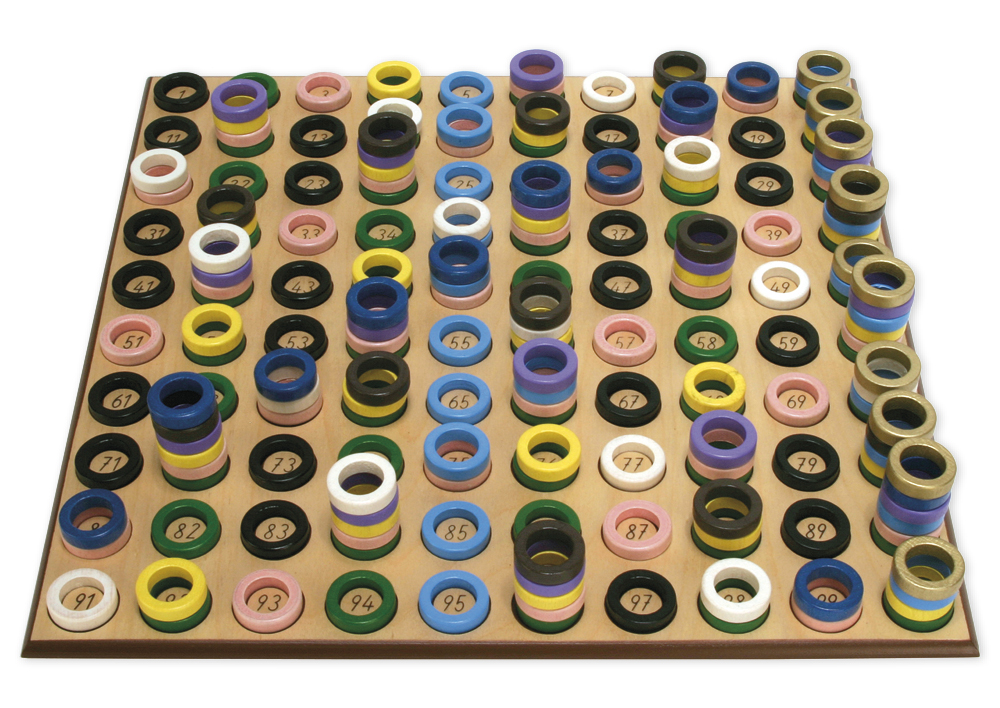
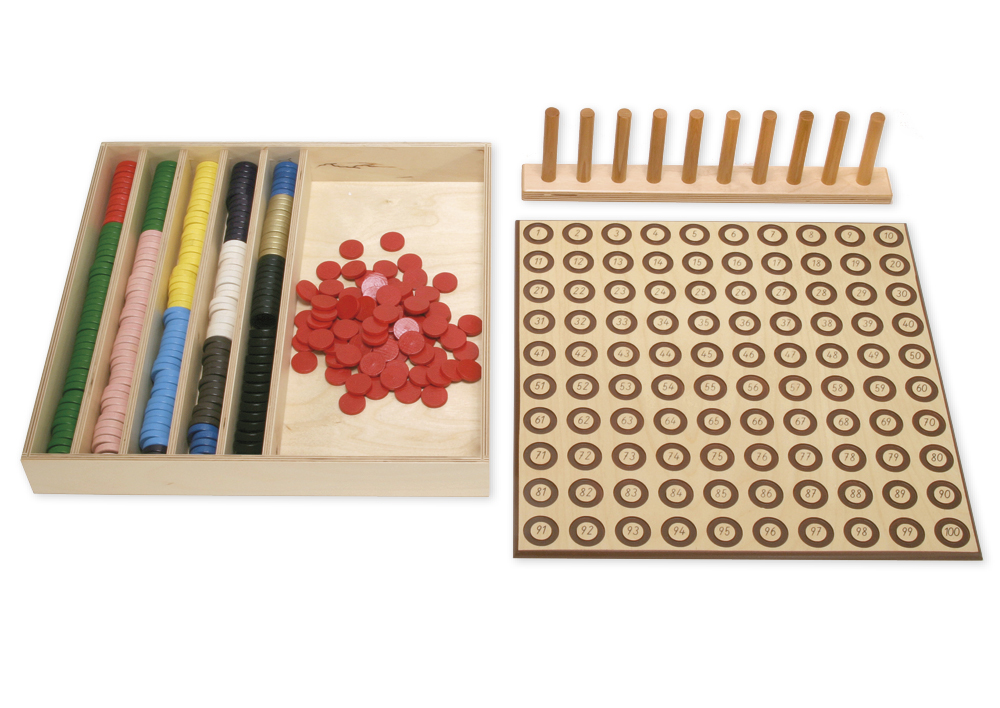
It comprises one wooden board that is printed with the numbers 1 - 100 and equipped with 100 ring-shaped pieces. It comes with a matching wooden box and wooden rings that are painted in the 10 Montessori colours. Black rings represent prime numbers. The precise milling means that the wooden rings can be purposefully placed and stacked. The numbers printed on the wooden plate remain visible by using rings instead of chips when working. The ring board is therefore good for the complex development of numbers up to 100 and takes the following aspects into consideration: Structure of numbers up to 100, layout of times tables up to 100, elaboration of prime numbers (sieve of Eratosthenes), smallest common multiple and largest common divisor.
Learning opportunities
Exploration of multiples in the hundreds.
Range of uses
School
Method - didactic information
The child chooses a times table (e.g. the three times table), takes pink rings and lays them on all numbers that are divisible by 3. When working on a second times table, overlaps will appear. The prime numbers will be left over.
Presentation & exercise
The children learn to count and discover the orientation of the hundred board. What number is where, predecessor or successor, the realisation that all equal units are arranged vertically and all equal tens are arranged horizontally. In this phase of learning, the chips included can also be used. Cover numbers and ask which number is hidden below, or issue orders to cover different numbers. Countless exercises are possible for consolidating these numbers.
Another working possibility with the ring board is creating 1 x 1 rows. Because it is usually only up to 10 x ... that is worked on at the beginning, the ring stand is used here. There are 10 rings per colour (except black) in ascending colours on the stand = number order from 1 - 10 available. Can be checked using your own example showing every times table. Of course, the children are allowed to lay out the boards according to the pattern. This is about automising the times tables. Lots of children are already able to go past 10 x ... because it is exciting to know how much 15 x 3 is, for example, and that it can be calculated.
The next step is now laying out ""related"" times tables, e.g. 3, 6 and 9. This is when it becomes clear why the board is called a ""ring board"" and not 1x1 board. That's because now the rings are laid on top of one another. For example, when laying out the 3, 6 and 9 times tables, there are three rings of different colours on the number 18. The terms ""divider"" and ""multiple"" should be introduced now at the latest, because the board clearly shows what belongs together.
Prime numbers: When the child lays out all times tables up to 100, following the Montessori colours, some numbers will remain empty. This makes prime numbers easy to see. The ring board is now also an exciting working tool for older pupils, who can work out the division rules and prime numbers in the number range up to 100 with solid material, without paper and pen. This can also be checked using the familiar times table structure.
Prime factorisation: Perhaps the most interesting detail of the ring board is that the board can be used for prime factorisation and rhus for determining the greatest common divisor and lowest common multiple. The ring board makes this easy and clearly possible. The child marks the number 18 on the empty board with a chip to avoid confusion. Now you begin with the smallest prime number, 2, say 18:2=9 and place the green ring for prime factor 2 on 9. Now the smallest possible prime number is 3. 9:3=3, a pink ring goes to 3. The smallest possible prime number is again 3, 1 pink ring goes to 1. Now the laid out rings are collected, sorted and the corresponding numbers written down – in this case, 1 green ring and 2 pink rings, i.e. 2x3x3=18, so the prime factors are 2, 3 and 3. To determine the largest common divisor and smallest common multiple of two or more numbers, the determined prime factors of the numbers just have to be combined and calculated accordingly.
Due to the various possible uses of the ring board, it is suitable as work material for children from 3 years of age and can be used right through to the sixth year of school and beyond. The rings are sturdy and easy to grip, and if rings go missing, you can order more at any point. Some replacement rings are included in the contents.
Size: 45 x 45 x 7.5 cm, ring diameter 3 cm
Material
Beech wood
Environment & safety
Sustainably grown wood
! This is educational teaching material, not a toy. Does not contain small pieces! Only to be used under supervision of a trained specialist!
- for complex calculations in the number range up to 100
- range of uses possible
- prime numbers, least common multiple and greatest common divisor
- suitable for school years 1-6
Teaching materials
Product information
This product is designed for teaching and education purposes only under the supervision of an adult (for example, a teacher/trainer).